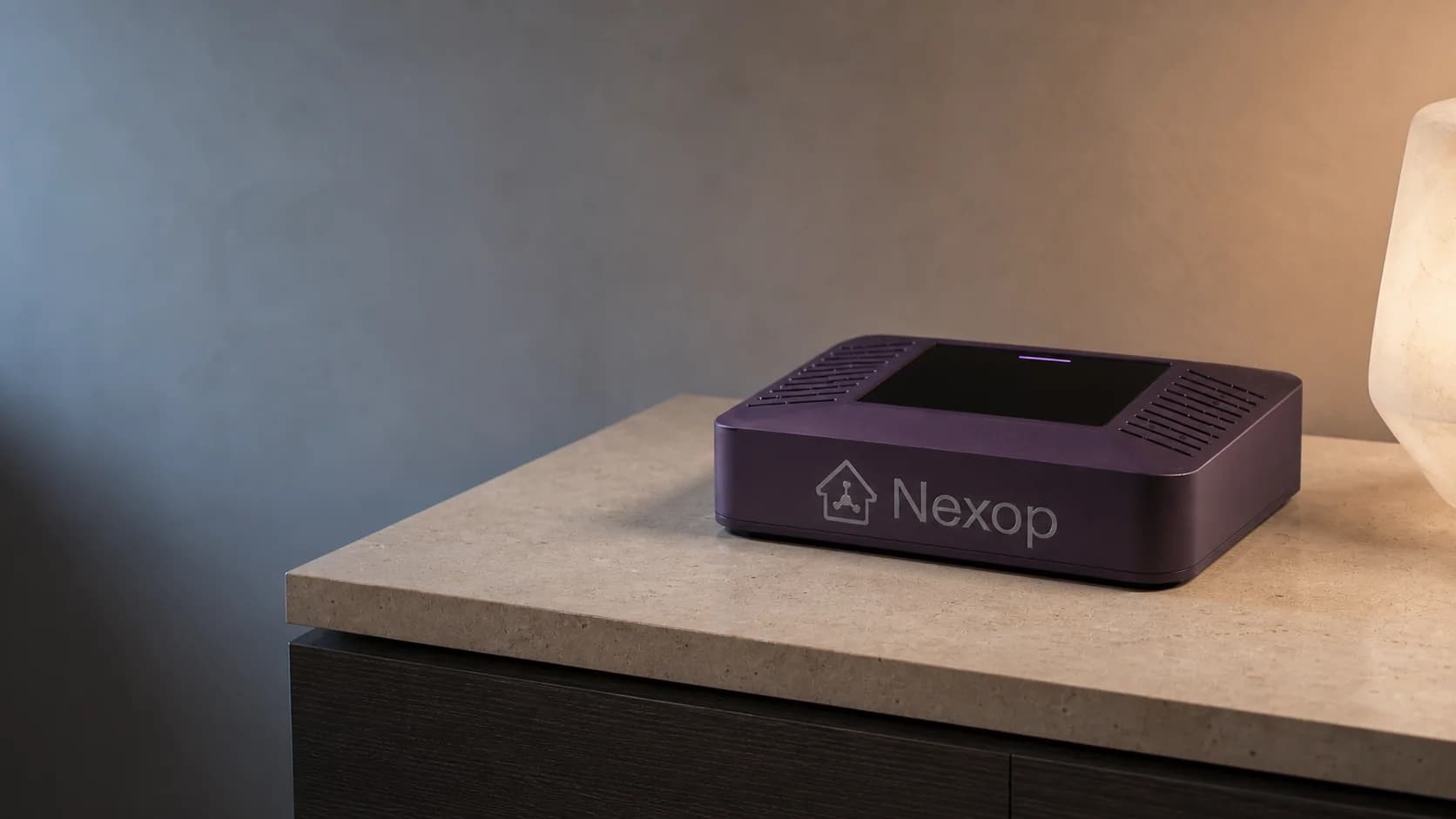
We've written about why a home should propose automations rather than wait to be told. That post was about the principle. This one is about the mechanics, including where they run out.
The raw material is duller than people expect
There's no camera in this, and no microphone. The input is the event stream a normal smart home already produces:
- Presence and motion: which rooms are occupied, when, and for how long
- Contact events: doors and windows opening and closing
- Environment: temperature, humidity, light level, air quality
- Device state: what was switched on or off, and to what setting
- Time: the timestamp on every one of the above
That's it. The interesting part isn't the individual events, it's that the same shapes keep recurring. A household is far more repetitive than the people in it believe.
What counts as a pattern
A useful pattern needs three properties, and dropping any one of them produces bad suggestions.
Repetition, meaning it happened enough times not to be chance. Once is noise, twice is coincidence.
Consistency, meaning it happens at a similar time or reliably after the same trigger. "Sometime in the evening" isn't a pattern. "Within twenty minutes of the living room becoming occupied after 18:00" is.
Co-occurrence, meaning several things move together. Lights dimming and blinds closing and the TV coming on is a scene. A light dimming on its own is just a light dimming.
That third one separates a suggestion worth making from a trivial observation. Individual events are usually boring. The intent lives in the clusters.
Why seven days
Long enough to see every weekday and both weekend days at least once, short enough that nobody is waiting a month for the product to do anything.
It's a compromise, and it has a real consequence: a one-week window can't distinguish a habit from a fortnight. Someone who works from home on alternating Fridays looks, to seven days of data, like someone with one consistent Friday behaviour. Longer observation improves this, and so does continuing to learn after the first suggestions. The initial week is a starting point, not the end of learning.
Confidence, and the asymmetry that governs it
Every candidate pattern carries a confidence score: how often it held, how tightly clustered the timing was, how many devices moved together, how recently it was last seen.
The threshold for surfacing a suggestion is deliberately high, because the costs are lopsided. A good suggestion earns a little trust. A bad one costs a lot, and a bad one involving a lock or a thermostat can end the relationship entirely. Ten useful proposals don't offset one that made somebody feel their house was guessing.
So the system stays quiet when it isn't sure. A proactive product that surfaces everything it noticed becomes noise, and noise gets dismissed without being read, which is a worse outcome than saying nothing.
Curious whether Nexop fits your home?
Book a live demo, run by one of the founders rather than a salesperson. Or join the waitlist and hear from us the day it ships.
What this can't learn
The honest part, and the reason we'd rather you read this than a feature list.
It can't see reasons. The system knows the bedroom light comes on at 03:00 twice a week. It doesn't know whether that's a newborn, insomnia or a night shift, and the right automation differs completely for each.
It can't see anything without a sensor. No sensor, no signal, and a household's most important routines are often invisible to the hardware installed.
It can't catch rare but important events. A pattern that occurs monthly won't clear a confidence threshold built for weekly rhythms. Some genuinely valuable automations are simply too infrequent to infer.
It can't tell preference from tolerance. Repeated behaviour shows what people do, which isn't the same as what they'd choose. Somebody might turn the heating down every night because the schedule is wrong, not because they like it cold, and automating that entrenches a workaround.
And it can't tell who did it. Aggregate presence doesn't identify individuals, so a household with different preferences per person looks, in the data, like one inconsistent person.
That last group is exactly why the output is a suggestion with its evidence attached rather than an action. The system contributes the observation, which humans are bad at for their own behaviour. The human contributes the meaning, which the sensors can't see.
Why this has to run locally
Doing this well needs continuous, fine-grained observation of when people are home, asleep, and moving between rooms. That's the most intimate data a house produces.
Streaming it somewhere to be processed would be a poor trade, and we wouldn't run it in our own homes. Keeping the learning on the device is what makes continuous observation acceptable in the first place. The recording and the reasoning both stay inside the building.
Nexop is pre-launch, and this is the newest part of the product. What's described above is how it's built to work, not a track record. If you want to see it running on a real home and push on the failure cases, book a demo. Those questions are more useful to us than the easy ones.