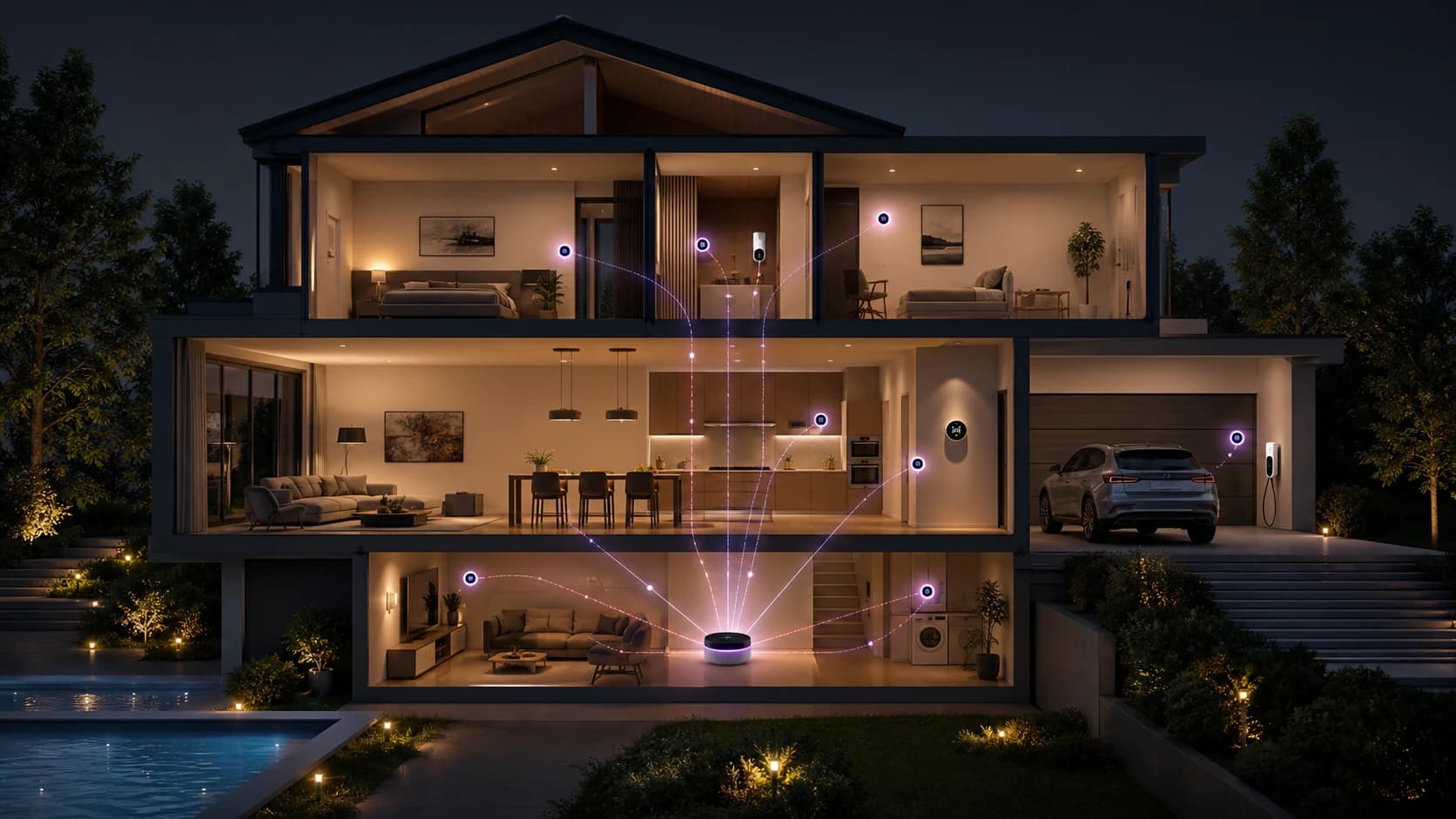
There's a particular kind of house that consumer smart home products ignore completely: one with excellent automation infrastructure already in the walls, running software that feels a decade old.
These are KNX homes, and there are a lot of them across Europe and increasingly across Asia. The hardware is superb. The experience of living with it, often, isn't.
Why the hardware isn't the problem
KNX gets described as legacy, which is unfair to the point of being backwards.
It's a wired bus: twisted pair to every switch, sensor and actuator, carrying data and power. It's an international standard rather than one vendor's protocol. And it's decentralised, so devices hold their own logic and talk to each other directly. There's no hub whose failure darkens the house.
The practical result is a lifespan nothing wireless can match. A KNX installation commissioned twenty years ago still works. Its actuators weren't discontinued, its bus never required a firmware migration, and no vendor switched off a server it depended on. Set against the smart home graveyard described in our post on cloud dependency, that's a remarkable record.
The trade-offs are real and well known. It has to be planned during construction or a serious renovation, the devices cost considerably more than wireless equivalents, and commissioning needs a trained installer with dedicated software. Nobody retrofits KNX into a flat on a weekend.
But the reason people with KNX get frustrated is almost never the bus.
The gap is the layer on top
Changes require the installer. Rebinding a switch or adjusting a schedule often means booking someone who has the project file and the software. For a homeowner who just wants the hallway light to behave differently, that's a wildly disproportionate amount of friction.
The visualisation is dated. Many KNX interfaces still look and behave like building-management consoles, because that's their heritage. They're dense, technical, and clearly not designed for whoever else lives in the house.
The logic is static. KNX executes exactly what it was commissioned to do, faithfully, for decades. What it can't do is notice that the household's routine changed two years ago. The configuration still reflects the family who lived there at commissioning.
And it doesn't speak to the wireless half. Most KNX homes have accumulated Zigbee sensors, WiFi cameras and Matter devices alongside the bus, and those end up as two parallel systems with no shared context. The split is invisible to the wiring and very visible to the people living there.
Curious whether Nexop fits your home?
Book a live demo, run by one of the founders rather than a salesperson. Or join the waitlist and hear from us the day it ships.
What a modern layer could add without touching a wire
This is the interesting part, because the fix doesn't require disturbing the installation at all.
A shared context across both halves, first. A Zigbee presence sensor should be able to inform a KNX lighting group. The bus is perfectly capable of receiving that instruction. Nothing has been coordinating it.
Plain-language control, so that "warm the study" doesn't require knowing which group address corresponds to which actuator.
Logic that adapts. A commissioning file is a snapshot of one moment. Software that watches how the house is actually used can propose adjustments the original configuration could never have anticipated, while leaving the underlying KNX programming intact as the reliable floor.
And changes without a callout. Not every adjustment should need the installer. The safety-critical and structural parts, yes. Moving a scene half an hour later, no.
All of this sits above the bus. The actuators, the wiring and the commissioned logic stay exactly as they are, and they keep working if the software layer is removed.
Why most products skip KNX
Consumer smart home companies target retrofit, because that's where the volume is. KNX is a small, wired, professionally installed market with a high technical bar, so hubs support Zigbee and Matter and Thread and leave KNX to the building-automation vendors.
That leaves an odd gap. The homes with the best automation hardware get the least modern software attention.
Our side of it
Nexop supports KNX natively, alongside Zigbee, Matter and WiFi. That combination is the whole reason for the product: a house with a bus and a pile of wireless sensors is running two disconnected systems, and joining them is a software problem, not a wiring one.
To be clear about scope, Nexop is a layer on top. It isn't a replacement for KNX and it isn't a substitute for your installer. The commissioned logic stays as the reliable base. We're not suggesting you re-engineer a system that has worked for twenty years, we're suggesting something better on top of it.
The usual caveat applies: Nexop is pre-launch. Worth noting too that Homey Pro, which we recommend elsewhere for its breadth of wireless protocols, doesn't support KNX. If you have a bus, that particular comparison goes differently.
If you live in a KNX home and this describes your experience, book a demo. We mean that: we want to talk to people in these houses, because they're the hardest and most interesting case we're building for.