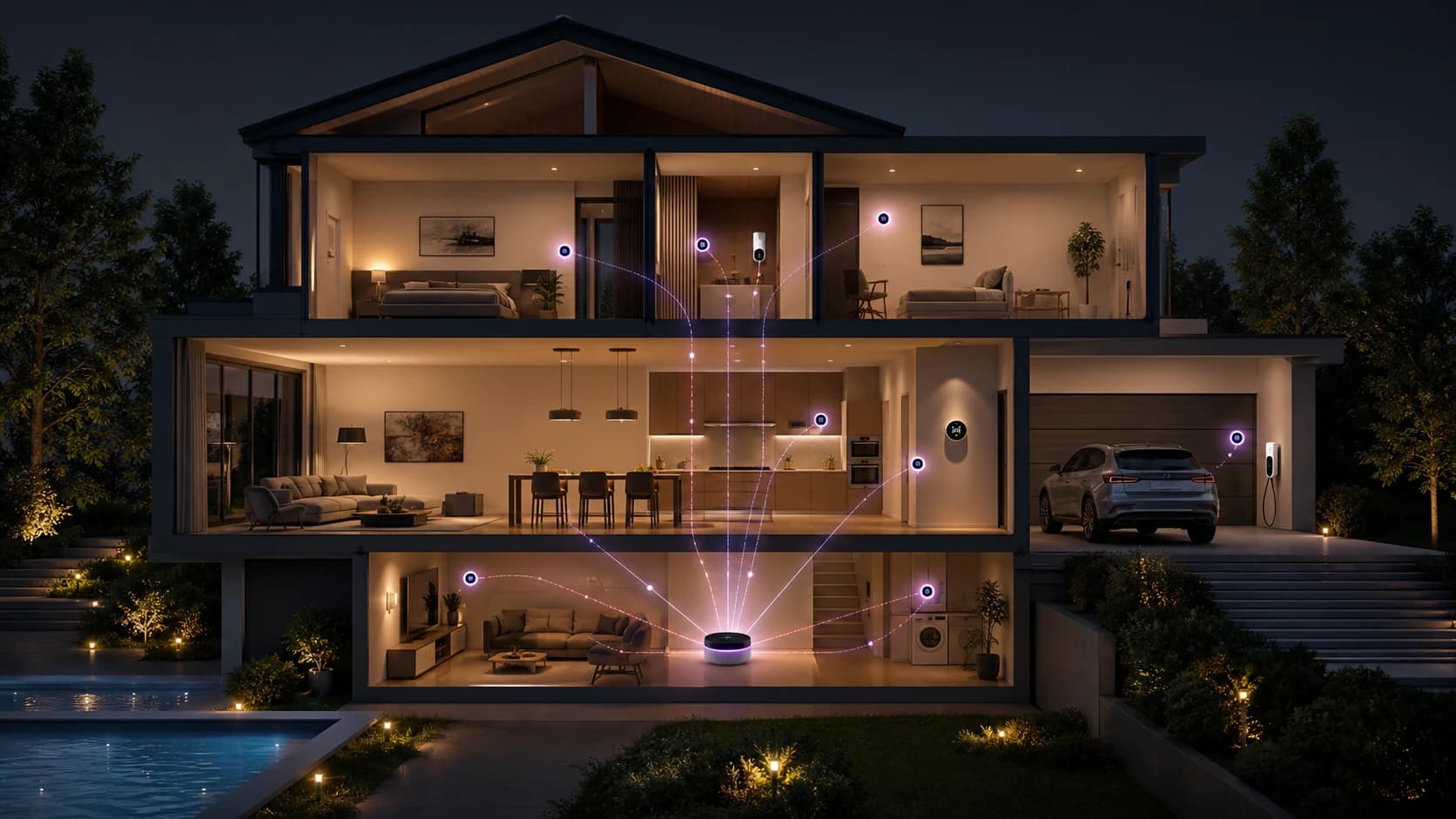
Almost every guide to smart home protocols drops Zigbee, Matter, KNX and WiFi into one table, gives you columns for range and frequency, and invites you to pick a winner.
The table isn't the problem. The framing is. These four aren't alternatives to each other, and working out why is the single most useful thing you can learn about smart home protocols.
The distinction that makes everything else make sense
Two different jobs are happening here, and they get discussed as though they were one.
Some protocols are the radio. They decide how a signal physically gets from a sensor to a hub: what frequency it uses, how far it reaches, how much battery it costs, whether devices relay for each other. Zigbee, Thread, WiFi and Z-Wave are radios.
Others are the language. They decide what a device says once the signal arrives: how it describes itself as a light, what "set brightness to 40%" looks like on the wire, how it gets paired and secured. Matter is a language.
So "Zigbee vs Matter" is a category error. Matter runs over radios: WiFi, Ethernet or Thread. A Matter light is usually a WiFi or Thread light that happens to speak a standard vocabulary. Zigbee is both a radio and its own older vocabulary bundled together, which is where a lot of the confusion starts.
KNX is neither, because it's mostly not wireless at all.
Once that clicks, the rest is straightforward.
The radios
Zigbee
A low-power 2.4 GHz mesh. Every mains-powered device relays for its neighbours, so coverage improves as you add devices rather than degrading. Battery sensors last months to years. It needs a coordinator, which in practice means a hub.
The reason Zigbee matters isn't elegance, it's ubiquity: it's what almost every cheap sensor uses. Its weakness is the neighbourhood. 2.4 GHz is crowded, shared with WiFi and Bluetooth, and older Zigbee devices had real trouble talking to each other across vendors.
Thread
The newer low-power mesh. Same underlying radio as Zigbee, but it speaks IPv6, so devices are addressable like anything else on your network. There's no single coordinator to bottleneck. Instead you need a border router to bridge Thread to your normal network.
Thread is the radio Matter was designed to shine on. One thing worth knowing: since January 2026, new border routers have to be certified to Thread 1.4, which was largely about making multi-vendor Thread networks behave when several ecosystems are present. That had been a real source of pain.
WiFi
No hub, and plenty of bandwidth, which makes it the right answer for cameras and anything that streams. It's also power-hungry, so it's the wrong answer for a door sensor running on a coin cell. Fill a house with WiFi devices and you'll meet your router's client limit sooner than you'd expect.
Z-Wave
Runs on sub-GHz frequencies, which buys it less congestion than 2.4 GHz and better penetration through walls. The cost is lower bandwidth. Certification is stricter, so cross-vendor behaviour tends to be more predictable than Zigbee's.
The rest
Bluetooth LE is mostly for setup and proximity rather than for running a house. 433 MHz is legacy and often one-way, and it's still worth supporting because plenty of older kit uses it.
Matter, and what it does and doesn't fix
Matter is the industry's attempt to stop every ecosystem inventing its own vocabulary. A Matter device should pair and work across ecosystems without a vendor bridge sitting in the middle.
It has taken longer than the announcements implied. Matter reached 1.4 in late 2024 and has kept iterating since, but ecosystems adopted it at very different speeds. In 2026 it's still normal to find two Matter devices whose supported feature sets don't quite line up. Better than it was, then, and not the universal solvent it was sold as.
The practical point when you're buying a hub is that "supports Matter" is an incomplete claim. Matter runs over WiFi, Ethernet and Thread. A hub that speaks Matter over WiFi but has no Thread radio can't talk directly to a Thread-only Matter device. Both hubs will say Matter on the box. Ask which transports.
Curious whether Nexop fits your home?
Book a live demo, run by one of the founders rather than a salesperson. Or join the waitlist and hear from us the day it ships.
KNX, the outlier
KNX belongs to a different conversation, and it's worth understanding even if you'll never buy it.
It's a wired bus. A twisted-pair cable runs to every switch, sensor and actuator, carrying data and power together. There are radio and IP variants, but wired is the heart of it. It's an international standard, and it has been in buildings for decades.
The architectural difference is that KNX is decentralised. Devices hold their own logic and talk to each other directly on the bus, so there's no hub whose failure takes down the lights. A KNX installation from twenty years ago still works, which isn't a sentence you can say about much smart home equipment.
The costs are real. It has to be planned and wired during construction or a serious renovation. Devices cost far more than their wireless equivalents. And it's programmed by trained installers using dedicated software, not by you on a phone app.
That's why KNX dominates European commercial buildings and premium residential, and is nearly absent from retrofits. If you have it, you have serious infrastructure and you're unlikely to rip it out. What it has historically lacked is a good modern software layer on top, which is a gap rather than a flaw in the protocol.
Working out what your house already has
You probably don't need to choose. Most homes are already mixed.
Start with what you own. Battery sensors and cheap bulbs are usually Zigbee. Cameras, TVs and speakers are WiFi. Anything bought in the last couple of years may be Matter, over WiFi or over Thread. If your house was wired for automation during construction, especially in Europe, check for KNX.
Then look at what needs a bridge today. A Philips Hue bridge, an Aqara hub and a SmartThings hub all plugged in at once are three separate Zigbee networks that could often be one.
Then ask what's missing. Usually it isn't a protocol. It's that nothing is coordinating across the ones you already have.
What this means when choosing a hub
The question people answer worst is the simplest one: which radios are physically in the box? Software can't conjure a radio. A hub without a Z-Wave chip will never speak Z-Wave, whatever a firmware update promises. Check whether a protocol is built in or needs a USB dongle, because the answer is often the dongle. Home Assistant Green, for instance, needs an add-on dongle for Zigbee and Thread.
After that, ask which Matter transports it supports, for the reason above. WiFi-only Matter and Thread-capable Matter are different products wearing the same word.
Ask what happens if the vendor's cloud goes away. A hub that translates protocols locally keeps working. One that round-trips through a server doesn't.
And ask whether one hub can replace the bridges you're already running. Consolidating three vendor bridges into one is usually a bigger practical win than gaining a protocol you don't own anything for.
Where we land, gaps included
Nexop natively supports Zigbee, KNX, Matter and WiFi. The combination is deliberate: Zigbee because it's what most existing sensors use, WiFi because it's what most existing appliances use, Matter because it's where new devices are heading, and KNX because wired installations have excellent hardware and have been badly served by software.
The gaps, since you'd find them anyway. Z-Wave, Thread, infrared and 433 MHz aren't supported at launch, and our Matter support runs over WiFi and Ethernet rather than Thread. If your home runs on Z-Wave, or is built around Thread devices, Homey Pro covers more radios than we do today. We'd rather you read that here than discover it after buying.
We're not betting on winning the radio count. The bet is that once devices are connected, transport stops being the interesting problem, and what's left is that nothing is proposing automations instead of waiting for you to write them.
If you want to see that running on a real home, book a demo. If you're still working out whether a local hub is the right category at all, the FAQ covers the common objections.