Ask somebody with a well-configured smart home how many automations they run, and the number is usually small. Ask how many they meant to build, and it's much larger.
That gap is the whole problem. It isn't capability: every modern hub can express far more than most households ever ask of it. The gap is that turning a vague preference into a working rule is work, and the work never stops.
Proactive automation is an attempt to close it from the other side.
What people mean by "automation" today
Nearly every system in use is reactive. You specify a trigger, a condition and an action. When motion is detected after sunset, turn on the hall light at 40%. The system executes exactly what you described, reliably, forever.
That's good engineering. It's also a programming task wearing a friendlier interface, and the costs compound.
You have to anticipate. You can't automate a pattern you haven't consciously noticed, and most household routines are invisible to the people performing them.
You have to maintain. Seasons change, people move rooms, a child starts school. Rules that were right in March are wrong in September and nothing tells you, so you just start working around your own automations.
You have to handle every edge case yourself. Guests. Illness. Holidays. Each exception is another condition you have to think of and encode.
The result is the pattern we keep seeing: enthusiastic setup, a handful of solid automations, then a slow drift into using the app as a remote control.
What proactive means
A proactive system inverts the direction. Instead of you describing a pattern to the house, the house describes a pattern to you.
It observes for a while, in our case a week, doing nothing. It notices that the bedroom cools after 21:00 on weeknights, that the kitchen and the blinds activate together after 08:00, that nobody is present after Tuesday lunchtime. Then it proposes:
You dim the lights and close the blinds around 20:30 most weeknights. Want me to do that automatically?
You approve it, adjust it, or ignore it. If you ignore it, it should stop asking.
The shift that matters is that you never had to notice the pattern yourself. The system did the observation, which is the part humans are worst at when it comes to their own behaviour.
Curious whether Nexop fits your home?
Book a live demo, run by one of the founders rather than a salesperson. Or join the waitlist and hear from us the day it ships.
Why it has to suggest rather than act
This is the part that gets designed wrong, and it's worth being blunt about.
A system that acts on inferences without asking isn't a smarter home, it's an unpredictable one. Unpredictable is worse than manual, because manual at least fails in ways you understand. If the lights dim and you don't know why, you haven't gained a feature. You've lost control of your living room.
There's a trust asymmetry that makes this unforgiving. A good suggestion earns a little credit. A wrong action costs a lot, especially where locks, cameras or heating are involved. Ten helpful inferences don't offset one unexplained door unlock.
So we hold ourselves to a few rules:
- Observe before acting. A week of watching, no actions taken.
- Propose, never impose. Nothing changes without approval.
- Explain the evidence behind a suggestion, so you can judge whether the reasoning is sound rather than whether the outcome felt nice.
- Make rejection permanent. A system that re-proposes what you declined is nagging.
- Keep manual control absolute. A physical switch always wins.
Where this goes wrong
Being honest about the failure modes is more useful than a feature list.
Correlation isn't habit. Two things happening together for a week doesn't make a routine, and a visiting relative can produce a very convincing pattern that will never recur.
Some suggestions are technically right and socially wrong. A system might correctly infer that a bedroom is unoccupied at 3pm on weekdays and helpfully propose turning off the heating, which is exactly wrong if somebody is ill in bed. Homes have context that sensors don't capture.
Then there's creepiness. There's a real line between "your home noticed" and "your home is watching you", and the same accuracy can land on either side of it depending on how it's surfaced. Local processing helps, because the observation stays in the building, but presentation matters as much as architecture does.
And over-suggesting. A system that proposes something every day becomes noise, and noise gets dismissed without being read. Fewer and better beats more.
We haven't solved all of these. Anyone claiming they have, this early, is overselling.
Where we are
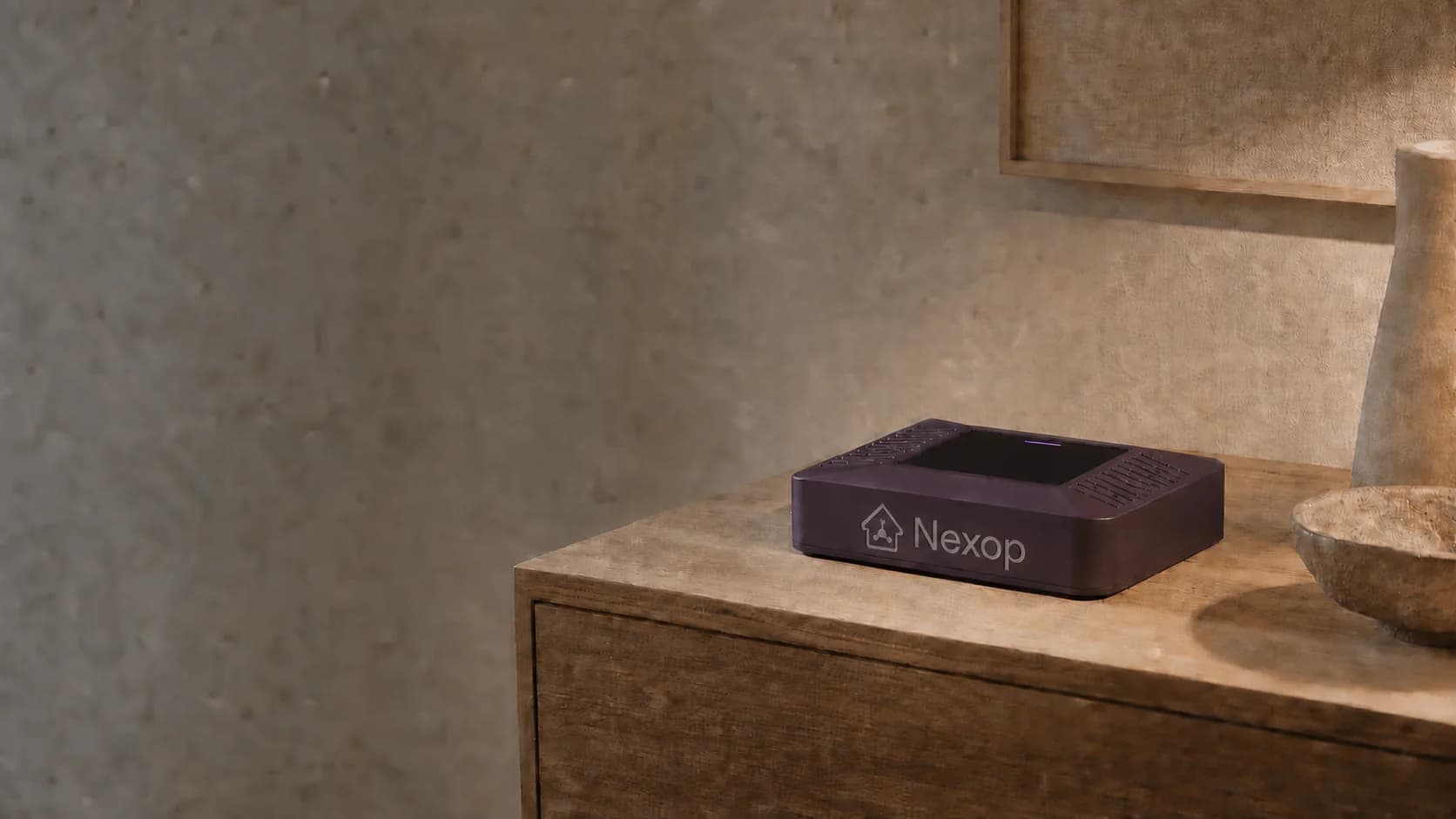
Nexop is being built around this idea: local observation, a week of watching, then proposals you approve, edit or ignore. The intelligence runs on the device in your home, which is what makes continuous observation acceptable in the first place. The alternative is streaming your household's rhythms to a server, and we wouldn't run that in our own homes.
Nexop is pre-launch, and the proactive engine is the newest part of it. The systems we compare ourselves to are shipping today and are excellent at what they do. Home Assistant and Homey Pro both give you superb tools for building automations by hand, and if you enjoy that, you may not want this at all.
This is for the other group: people whose homes could do far more than they currently do, and who are never going to sit down and write the rules.
If that's you, join the launch list or book a demo and watch it propose something on a real home.