Search for a smart home hub and you'll be shown four different categories of product under one word. A Zigbee bridge is a hub. An Echo is a hub. Home Assistant is a hub. A $10 dongle is a hub.
They do very different jobs, and the confusion has a cost. People buy the wrong one, conclude that smart homes are a mess, and aren't entirely wrong.
So here are the categories separated out, including where a local AI hub fits and where you'd be better off with something else.
The four things people call a hub
A radio bridge translates one protocol. A Zigbee or Z-Wave stick lets your computer talk to devices that don't speak WiFi. It has no opinions and no intelligence. It's a translator, and that's the whole job.
A cloud hub is an Echo, a Nest, or a SmartThings box. It connects to your devices and sends the interesting parts to a vendor's servers, where the decisions get made. Cheap, capable, and dependent on two things staying true: your internet connection, and the company's continued interest in supporting the product.
A local controller is Home Assistant, Homey or Hubitat. Devices connect to a box in your house and the automations run there. Nothing has to leave the building for a light to turn on. What these do is execute rules, and the rules are yours to write.
A local AI hub is a local controller that also tries to work out what the rules should be. It watches what actually happens in the house and proposes automations instead of waiting for you to specify them.
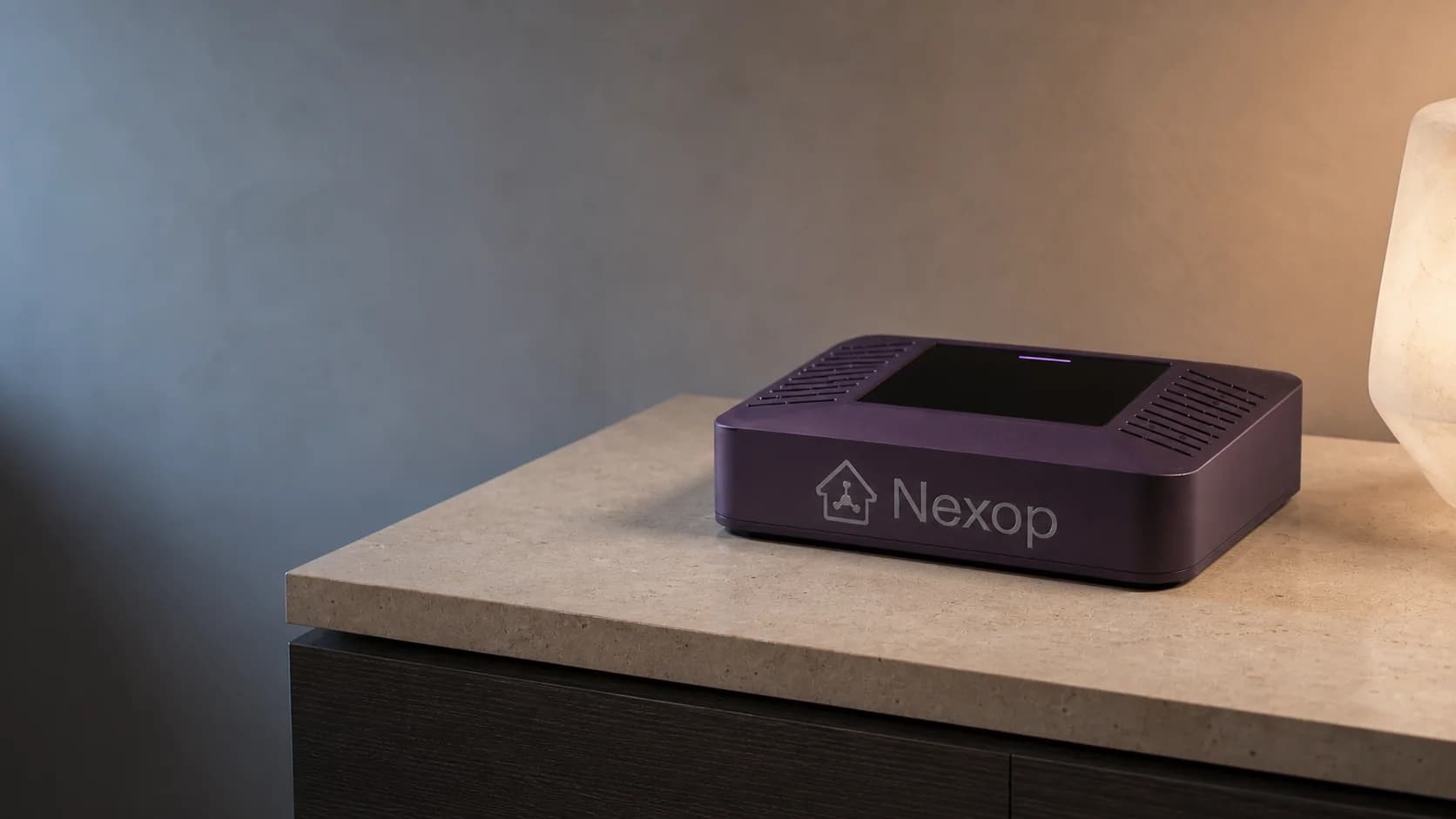
The first three are mature. The fourth is new and unsettled, and it's where Nexop sits.
What "local" is protecting
Local processing usually gets filed under privacy, which undersells it. Different people care about different parts of it.
Privacy is the obvious one. Occupancy, sleep patterns, comings and goings are unusually revealing data, and a local system doesn't need to transmit any of it to be useful.
Reliability is the one people feel. If the automations run in your house, your lights work when your broadband doesn't, and when the vendor has an outage. Cloud smart homes fail in a specific and infuriating way: everything is powered, everything is connected, and nothing responds.
Longevity is the one people notice too late. A cloud device works until the company decides otherwise. The graveyard of discontinued smart home products is large and still growing, and nothing in it stopped working because the hardware failed.
None of this means offline-only. Remote access and updates are perfectly reasonable uses of the internet. The distinction is whether your household context is the thing being shipped away, and whether the house stops being a house when the connection drops. We went into that difference in what local-first AI actually means.
Curious whether Nexop fits your home?
Book a live demo, run by one of the founders rather than a salesperson. Or join the waitlist and hear from us the day it ships.
Where the AI part comes in
Local controllers are powerful, and they put all of the work on you.
You decide that the hallway light should come on when motion is detected after sunset, but not if the living room is already occupied, and not after midnight unless somebody has just come through the front door. Then you build it. Then you find the edge cases. Then you maintain it.
People who enjoy that are well served already, and Home Assistant is superb for them. The problem is everybody else, who buys the hardware, builds three automations, and stops.
A local AI hub is a bet that the bottleneck was never capability. Your home already produces the signal needed to work out that you dim the lights around ten on weeknights. Something should be able to notice that and offer it to you, rather than waiting for you to specify it in advance.
Offer is the important word. A system that changes your home based on an inference, without asking, isn't helpful. It's unpredictable, and unpredictable is worse than manual. The version worth building observes, proposes, and lets you approve, edit or ignore.
How to tell which one you need
Buy a radio bridge if you already have a system you like and just need it to reach a device it currently can't.
Buy a cloud hub if you want the cheapest capable option, you mostly want voice control, and processing in someone else's data centre doesn't bother you. That's a legitimate position and the value is real.
Buy a local controller if you want your home to keep working independently of the internet, and you're willing to build and maintain the automations yourself. If you enjoy that, you'll hit its limits long after you hit ours. Home Assistant and Homey Pro are both excellent, and Homey supports more radio protocols today than we will at launch.
Consider a local AI hub if you want the independence of a local controller without signing up for a permanent configuration project. That's the gap Nexop is built for.
What to check before buying
Whatever category you land on, a few questions separate the marketing from the product.
Does it work when the internet is down? Not "does it have local control as a feature", but does the whole thing keep running. Ask what specifically stops.
What does it cost to keep? One-time purchase, subscription, or a free tier that will eventually have to make money somehow. All three are viable businesses. You just want to know which one you're entering.
Which protocols are native? Zigbee, Z-Wave, Matter, Thread, KNX and plain WiFi aren't interchangeable. Check them against the devices you already own, and check whether each one is built in or needs an add-on dongle.
Who owns the data, in writing? Not the marketing page. The privacy policy.
Where we sit
Nexop is a local AI hub. It plugs into your network, natively supports Zigbee, KNX, Matter and WiFi, learns your household's routines locally, and proposes automations for you to approve. One-time purchase, no subscription.
It's also pre-launch, which is the most important sentence on this page. The products it competes with are shipping today and ours isn't. If you need a hub this month, buy one of the ones we linked above. We mean that.
If the proactive part is what you've been waiting for, join the launch list or book a demo and watch it run on a real home before you decide anything.