The case against cloud-dependent smart homes usually gets made on privacy grounds. That argument is real, and we make it elsewhere.
This post makes the other one, which is less philosophical and often lands harder: cloud-dependent homes fail in ways that ordinary appliances simply don't. A light switch built in 1960 still works. A connected bulb from 2019 might not, and not because anything about it wore out.
Three failures that can't happen to dumb hardware
The first is that the connection drops. Your broadband goes down and the lights stop responding, not because power failed, but because the instruction to a bulb three metres away was routed through a data centre. Everything is powered, everything is connected to each other, and none of it moves. People find this one the most infuriating, because the house is visibly fine.
The second is a service outage. Your internet works; the vendor's platform doesn't. You have no control, no diagnosis, and no recourse except waiting. Large cloud platforms have unusually good uptime, but unusually good isn't always, and when it fails it fails for everyone at once.
The third is the one that ends devices permanently: the company changes its mind. Products get discontinued, servers get switched off, an acquisition closes a product line, a free tier becomes paid. The hardware is untouched and works perfectly. It just has nothing left to talk to. The smart home graveyard is large, and almost nothing in it broke.
Local processing removes all three, not by being more reliable in some abstract sense but by removing the dependency. A rule that runs on a box in your hallway can't be affected by a company's roadmap.
What "local" has to mean to actually help
The word gets used loosely, so it's worth being specific. There are three levels, and only the last one gets you everything above.
Local control means you can reach the device on your own network. Better than nothing, and often all that's being claimed.
Local automation means the rules execute in your house. The motion sensor triggers the light without a round trip. This is the level that survives an outage.
Local intelligence means the decision-making runs on your hardware too: the pattern learning, the language understanding. This is the newest and rarest level.
A product can honestly advertise local control and still go dark when the vendor's servers do. If reliability is what you're buying, ask specifically which of the three you're getting.
Curious whether Nexop fits your home?
Book a live demo, run by one of the founders rather than a salesperson. Or join the waitlist and hear from us the day it ships.
Audit your own home in an afternoon
This tells you more than any spec sheet, and it costs nothing.
Pull the plug first. Disconnect your router from the internet, leave the local network up, and walk around the house for ten minutes. Try the lights, switches, sensors, locks, thermostat. Whatever stops working is a cloud dependency you didn't know you had. Most people are surprised at least once.
Then count the accounts. Every vendor account is a company that has to keep existing for your hardware to keep working. That isn't a reason to panic, just a number worth knowing.
Check which devices need an app to do anything at all. If the only way to control something is a phone talking to a server, that device is a service, not an appliance.
And look for the bridges. Several vendor bridges usually mean the same protocol is being run several times over, which is often consolidatable. Our guide to which protocols matter covers what can collapse into what.
The counter-argument
A guide that pretended the cloud has no advantages wouldn't be worth reading.
Cloud services are better at some things. Voice recognition and general knowledge still favour large models running in data centres. Cloud video storage is offsite by definition, which is exactly what you want if someone steals the camera. Updates and remote access are simpler when a vendor handles them. And a cloud product often works instantly out of the box, where a local setup asks more of you.
The goal isn't zero internet. It's that the house shouldn't stop being a house when the internet stops. Use the cloud for what benefits from being remote, and keep the part that turns your lights on at home.
There's a cost argument here too, since cloud dependency is what makes subscriptions possible in the first place. That's covered in smart home without a subscription.
Our side of it
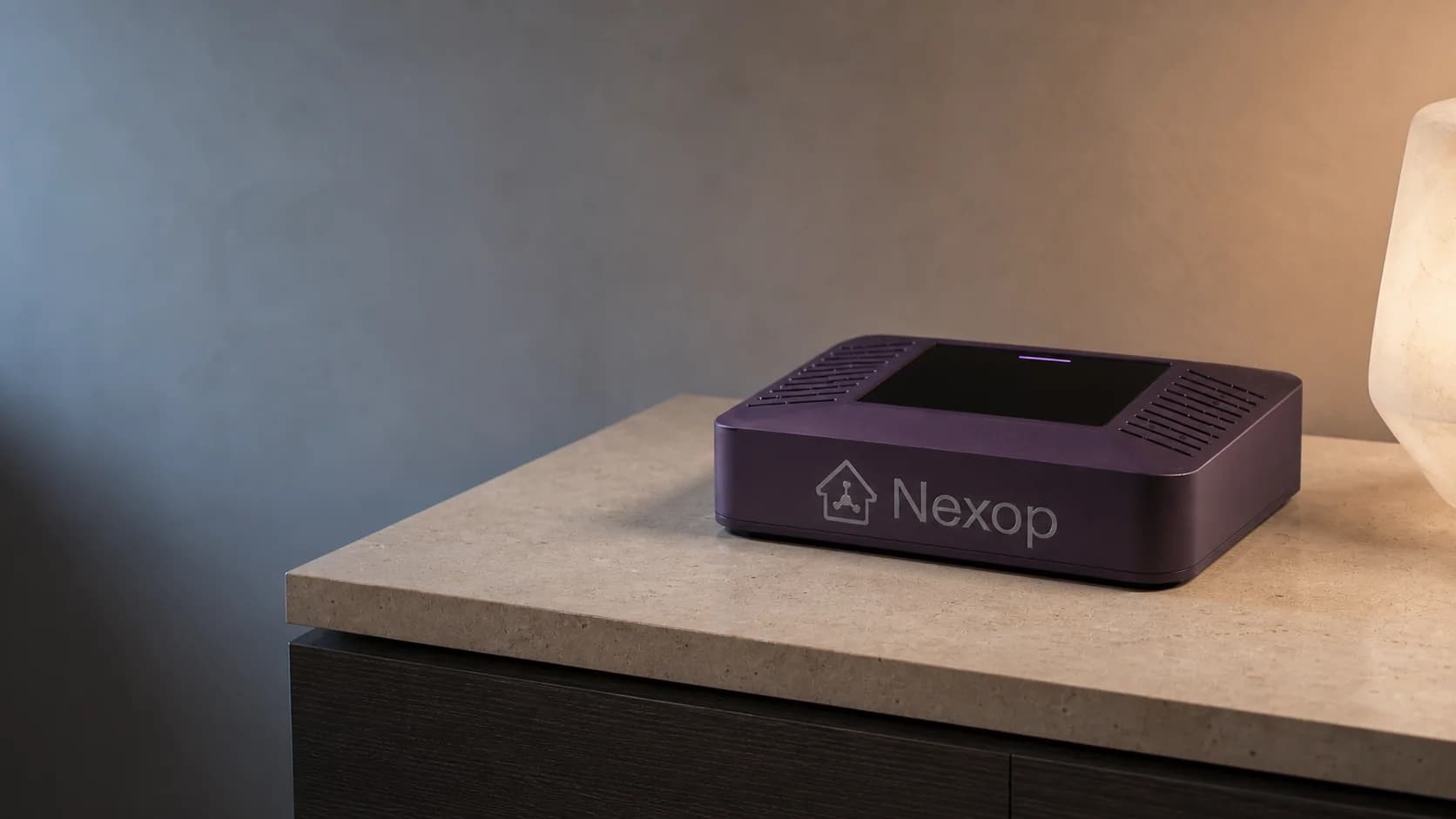
Nexop runs automations locally by design. The routine learning, the device state and the decision-making all happen on the device in your home. Disconnect the internet and the house keeps behaving.
That isn't a feature we added, it's a constraint we accepted, and it makes some things harder. Voice quality, remote access and updates all take more engineering when you refuse to route them through a server. We think the trade is right, because a home that depends on our servers is a home that depends on our company surviving, and nobody should have to bet their lighting on a startup.
Nexop is pre-launch. If you want the reliability argument satisfied today, Home Assistant and Homey Pro both run locally and both ship now. If you'd like to see our version running on a real home, book a demo.