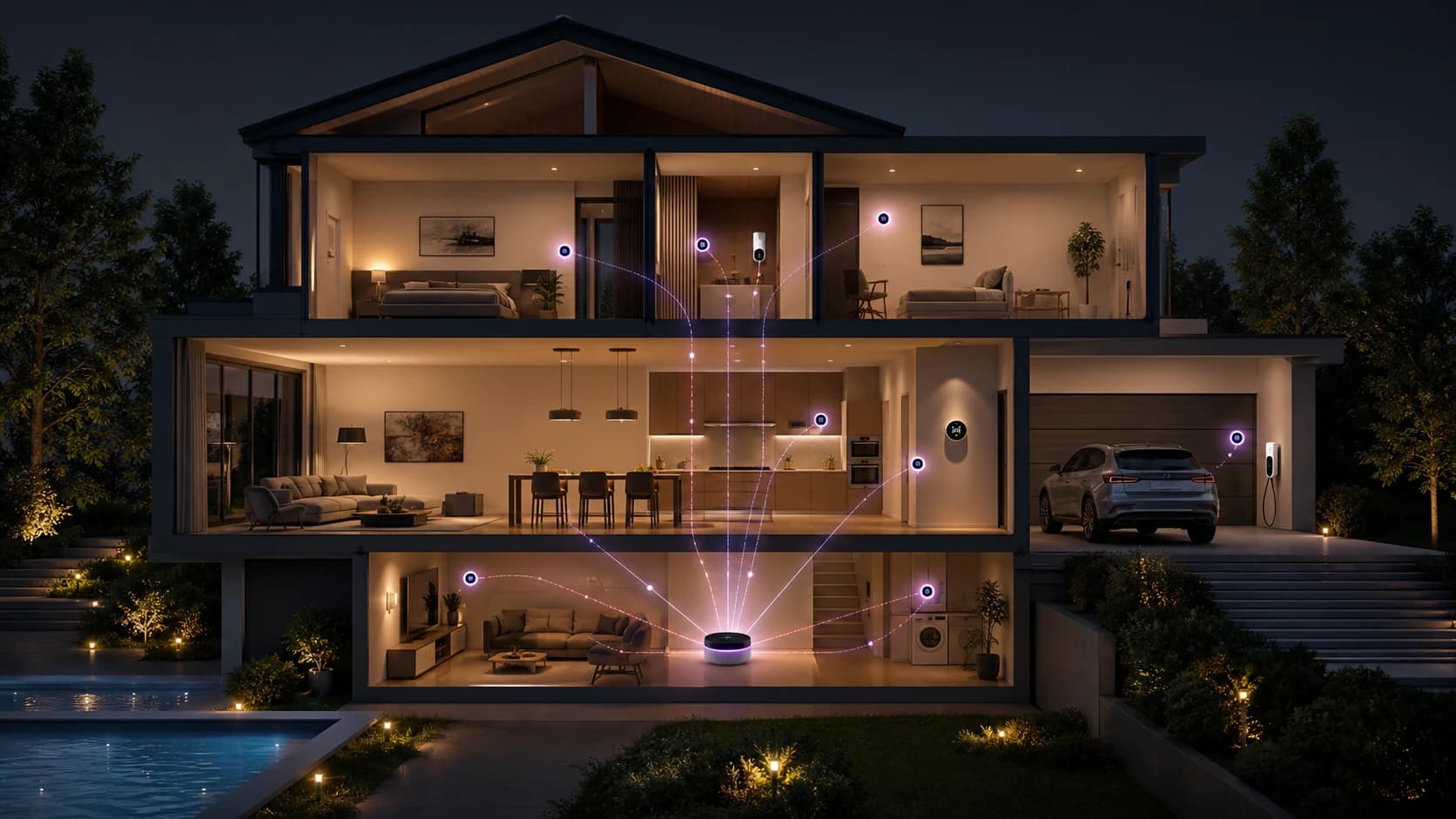
Local-first AI means the important intelligence runs inside your home instead of depending on a remote cloud service.
For a smart home that matters more than almost anywhere else. A home is full of personal signals: movement, occupancy, comfort preferences, security events, sleep routines, energy usage. Those signals shouldn't become somebody else's dataset by default.
Local-first isn't the same as offline-only
Local-first doesn't mean a product can never use the internet. It means the core experience doesn't depend on sending private household context to a remote server.
For Nexop, the home should keep working locally. Automations run locally. Routine learning happens locally. Device state is processed locally.
Cloud services can still be useful for optional updates, backups, remote access or integrations. They just shouldn't be the centre of the system.
Why it matters for automation
Good automation depends on context, and a motion sensor event on its own isn't enough. The useful question is what the event means.
Is somebody waking up? Did somebody just arrive home? Is the house empty? Is the living room occupied for a film? Is the kitchen busy in the morning?
The more context a system has, the more useful it can be, which is exactly why the privacy model matters. A system that learns locally can get more helpful without turning household behaviour into a cloud dependency.
Curious whether Nexop fits your home?
Book a live demo, run by one of the founders rather than a salesperson. Or join the waitlist and hear from us the day it ships.
What to expect from one
A local-first smart home AI should do a few things well:
- Discover devices without forcing every action through a vendor cloud
- Learn routines from local events
- Propose automations before applying them
- Keep manual control available
- Keep working when the internet is unreliable
- Make privacy the default rather than a premium feature
The practical tradeoff
Local-first systems need careful design. They have to run efficiently on small hardware, handle the differences between devices, and expose enough control for technical users without becoming complicated for everyone else.
That's the product problem Nexop is taking on, and we wrote about the thinking behind it in Why we're building Nexop.
Done right, you get a smart home that's intelligent and private at the same time. If you want to see local-first automation running on a real home, book a demo.